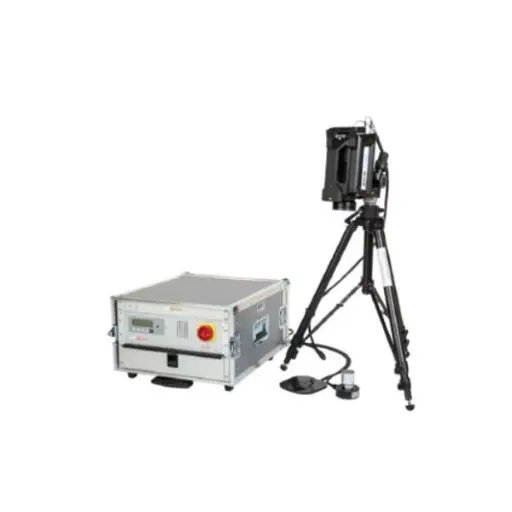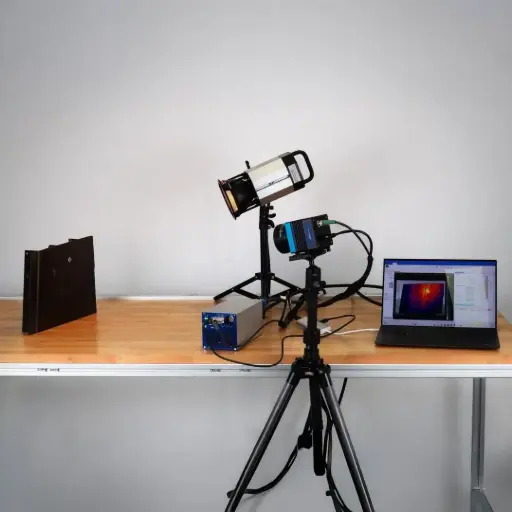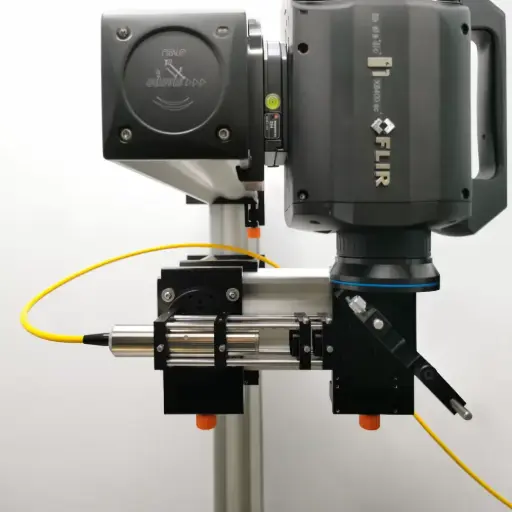
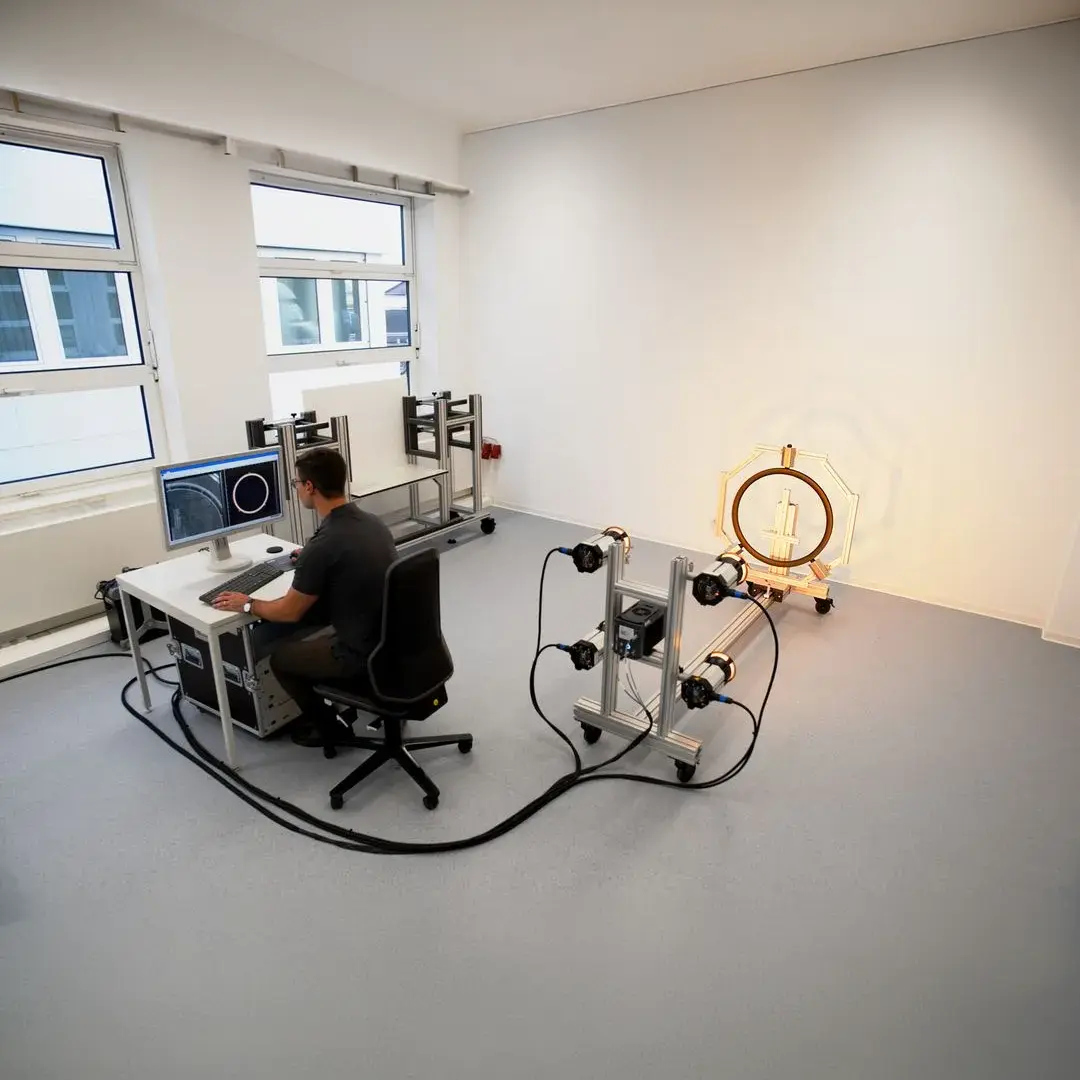
Edevis OTvis
A non-contact, non-destructive testing method that is particularly well suited to the analysis of CFRP components in the aerospace and automotive industries
Technical highlights
- Optically excited lock-in thermography
- High-resolution defect detection
- Modular, expandable system with IR cameras
User highlights
- ✓ Ideal for large and complex components
- ✓ Particularly robust & suitable for industrial use
- ✓ Full automation & rapid analysis
Applications:
- Electrical industry
- Automotive & Aviation
- Electronics development
- Research and Development
- Universities and higher education institutions
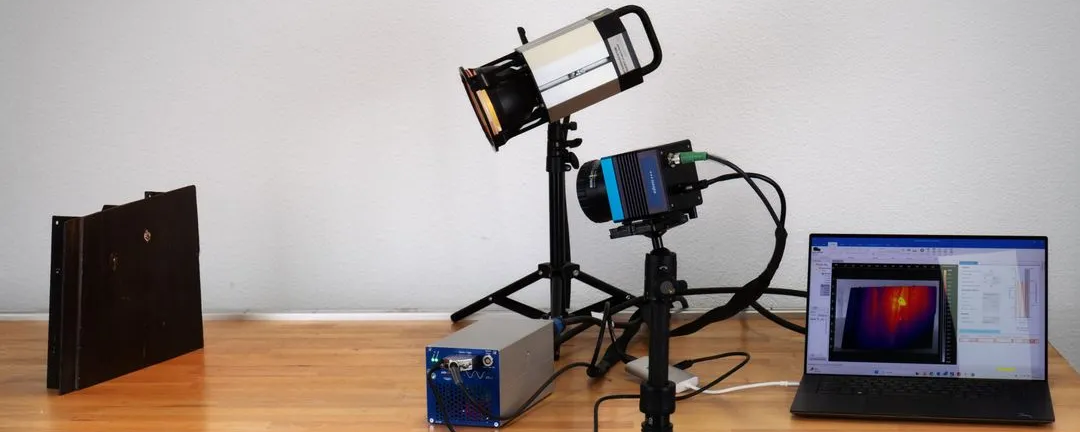
The Edevis OTVIS Lock-in thermography is a sophisticated method of non-destructive material testing. It uses modulated thermal excitation and phase-based analysis to reveal even the smallest defects.
The system operates using optical excitation, whereby defined heat pulses are applied to the test specimen. The resulting temperature profiles are analysed and converted into phase images . This method enables particularly sensitive detection of defects, even those located below the surface.
A key advantage lies in the high penetration depth of the analysis. Compared with conventional thermographic methods, hidden structures and defects can be reliably identified. This is particularly relevant for complex materials and composite structures.
The Edevis OTVIS Lock In Thermography system offers a high degree of flexibility and can be adapted to various testing requirements. It is suitable for use in both research and development and for industrial quality control.
Typical areas of application include:
• Testing of fibre-reinforced composites
• Analysis of delamination and inclusions
• Research in the field of materials characterisation
• Inspection of safety-critical components
The method delivers precise and reproducible results and significantly improves the reliability of thermographic analyses. It enables a well-founded assessment of material conditions without damaging the test specimen.
For applications with the most demanding requirements in terms of sensitivity and depth resolution, Edevis OTVIS Lock-In Thermography offers a high-performance solution.
Technical properties and features of this product.
| Spezifikation | Wert |
|---|---|
| Test procedures | Non-destructive testing (NDT) |
| Thermography method | Optically-stimulated lock-in thermography |
| Principle of stimulation | Contactless optical excitation using modulated light |
| Source of inspiration | Halogen lamps |
| Detection principle | Disruption of heat flow caused by defects (e.g. delamination, inclusions) |
| Imaging | Infrared camera (MWIR or LWIR) |
| Signal analysis | Fourier transform (phase and amplitude images) |
| Output power | approx. 3.6 kW / 4 kW / 6 kW / 8 kW / 12 kW (depending on the system) |
| Measurement principle | Depth-resolved fault detection and wall thickness measurement |
| System architecture | Lamp control + halogen lamps + software module |
Download the product documents directly or request further documents.
Request further documents